Reviewing the Edit Versus Formatting Review (for Authors)

Some publishers, including the one that employs me, give authors two reviews during the publishing process. The first—the review of edit—occurs after the manuscript has been developed and copyedited. During this time, the author sees his or her manuscript for the first time since sending it to the publisher. The author should read the file carefully, answering any queries left by the editor. The author should also make any bigger-picture changes he or she has been considering. Now, I’m not encouraging an author to rewrite the book. I’m saying if the writer thinks an additional paragraph or section is needed to strengthen a point, the author should do it now—before the file is formatted.

Once the file is formatted, a.k.a. begins to look like a book, the author receives a copy as an electronic PDF to do the second review, that is to (1) answer any outstanding queries and (2) confirm that the formatting looks like he or she intended, noting any errors. Errors will usually be surface level; perhaps a figure needs to be closer to its call-out or text should be reworked as a bulleted list. Ideally, major rewriting will not occur at this stage. If a lot of rewriting occurs, the file may have to be edited again, which can delay the book’s release.
In both reviews, I encourage authors to read the file carefully. Resolve all editor queries, and ask any questions that come to mind.

Happy editing!

Getting the Style Sheet Right

A style sheet is an invaluable tool that ensures consistency. Per The Chicago Manual of Style (2.52), “for each manuscript the editor must keep an alphabetical list of words or terms to be capitalized, italicized, hyphenated, spelled, or otherwise treated in any way unique to the manuscript.” The style sheet makes sure each volume in a series or title released by a publisher maintains the integrity of previous releases. Consider:

  • The author of a series will want to ensure her hero’s physical characteristics and background are consistent from book to book. For example, a hero identified as a six-foot detective with a degree in criminal justice from Michigan State University in book one would raise an eyebrow if he alludes to his eternal love for his college mascot, the Buckeyes, and his frustration at never being able to find pants for his five-foot frame in book three.
  • A Christian theology book should decide whether it wants to use God or god. Readers may question whether God refers to a single, supreme being and whether god connotes some less significant meaning.
  • Education publishers will want to be consistent in how they treat frequently used terms, like response to intervention, students with disabilities, and professional learning community but Professional Learning Community at Work.

When creating a style sheet, I make sure to:

  • Alphabetize my entries
  • Apply capitalization, italics, or other special treatments that have been decided
  • Make sure any style decisions are consistent with what’s been decided in the author’s or publisher’s previous books on the topic (In fact, I’ll copy the entries from the style sheet of the author’s last book onto the one I’m creating for the newer title.)
  • Copy any acronyms, mnemonic devices, definitions, questions, or other special elements the author lists. For example, “A KWL chart determines what a student knows, would like to know, and learns from a lesson.”

I always err on the side of giving too much information. My goal is a polished, professional book that’s consistent with its publisher and author’s previous works and that the next editor will find easy to follow.

There you have it!

Checking Photos

Whether editing or proofreading, it’s important to review photos for quality, clarity, and accuracy. Ask yourself:

  • Will the photo be reprinted in color? If so, is a full-color pic used?
  • Is the photo high resolution? I find that a JPEG, TIFF, or applicable format at 300 dots per inch (dpi) reprints well.
  • Is the photo appropriate for publication? With that question in mind—
    • Does the photo contain additional or unecessary people or irrelevant props?
    • Is the lightening good?
    • Is the background distracting?
  • Does the caption accurately reflect who’s photographed or what that person is doing?

The Television Academy had a mishap where actor Terrence Howard was mistaken for Academy Award-winning actor Cuba Gooding Jr. (oops); luckily, tweets are easier to delete than books are to correct. Still, don’t let a bad or inaccurate photo slip through the cracks on your watch.

Happy editing!

Querying Authors: How to Write Queries, When to Write Them

Sometimes it’s necessary to query authors to clarify an idea or concept. In my opinion, the best queries are straightforward, spelling out exactly what information you need. You want to respect the authors’ time and avoid any chance your request can be misinterpreted. Perhaps the authors said “Research says” or “Studies show”, but they don’t cite any of the research they’re drawing from. Lack of research can cause credibility issues. Readers need to be able to pull up the resources being quoted to verify the information for themselves. I’d leave a simple author query (AQ) like [AQ: Please cite the research you’re referring to, and provide a reference-list entry for each citation].

Note the bold font make the query standout from the normal text. I may also highlight it in yellow. This minimizes the chance that the query will be overlooked during the authors’ review. However, some programs like Microsoft Word offer Comment features that are also effective.

The following are the most common issues I (and I imagine other editors) have to query for.

  • Missing information: Author bios, photos, text, and research
  • Clarifying information: Perhaps the author makes an assertion that can be misconstrued. For instance, an author may say “We have to close the achievement gap in the United States. Minorities are earning four-year degrees at lower rates than other groups.” In this case, I need to know how the author defines the term minority. I’ve heard this term used to describe women, but the National Center for Education Statistics reports that women are earning degrees at higher rates than men, which would make the writer’s point inaccurate.
  • Making suggestions: In my field (education publishing), we want to provide educators with practical, research-based strategies and tools. Occasionally, authors will include sample rubrics or lesson plans in manuscripts. I may ask them if they’d like to make the material free to download on their book’s product page. This (1) provides teachers with an easy-to-access tool they can immediately use with their students, which in turn makes them feel grateful toward us and likely to buy our product again; and (2) draws readers to the book’s page where they can find other titles the author has published . . . which they will then buy.

It should go without saying that any queries should be respectful of the authors, their expertise, and the time they devoted to writing. Not only are they doing a service, they chose to work with you, so your dealings with them should demonstrate gratitude for their choice.

Understanding the Power of Partnership

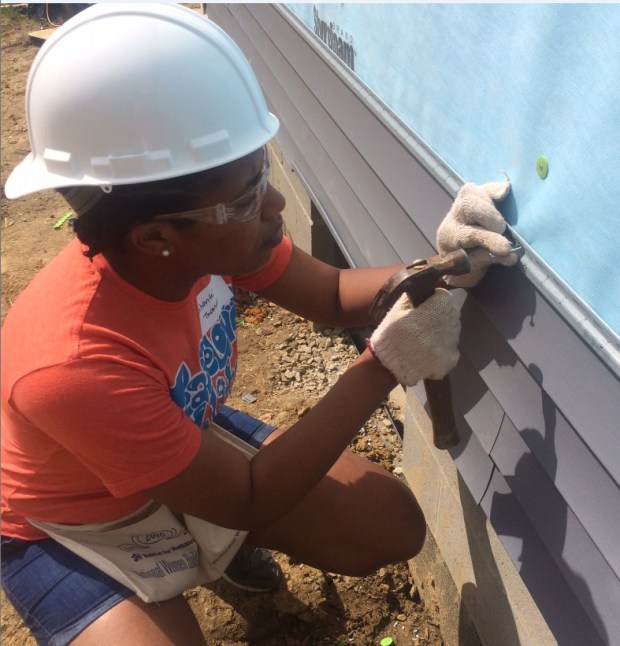
One of the reasons I chose to pursue a career in publishing is that I love helping people achieve their goals. I’d like to say that as a copy editor (and proofreader and project manager), I take a manuscript in its raw form and transform it into a polished piece, marketable to the public and accurately reflecting the author’s voice. However, that transformation can not be achieved without communication with the author and the production team. Behind every traditionally published book, there are editors, designers, sales people, marketing staff, accountants . . . and an author working together to realize the author’s dream. Nothing can be achieved without partnership.Build

Recently, I experienced partnership in a different way. This month I volunteered my love of helping people realize their goals during the annual Habitat for Humanity Women Build, where I partnered with hundreds of volunteers to build two families’ dream homes.
Each family has a unique journey that brought it to Habitat. However, they all share a desire for homeownership and the stability and security that brings. More than three thousand volunteer hours, $170,000 fund-raised, and two intensive weeks of building later, that dream has been realized.

Partnership: It works with books. It works for people.

Highlighting 3 Elements to Check During Proofreading

Proofreading is one of the final hands-on stages of the publishing process. At proofreading, the manuscript will receive a final read through. According to the University of Chicago Press’s (2010) The Chicago Manual of Style (Sixteenth edition), “Proofreading is the process of reading a text and scrutinizing all its components to find errors and mark them for correction.” All components encompasses more than reading the text. Proofreaders should also the following.

  • Verify the table of contents’ accuracy: One of the first things readers will see (and use) is a book’s table of contents (TOC). If it’s incorrect (for instance, it says chapter 2 begins on page 13 but it actually begins on 31), the author’s and publisher’s credibility will be damaged. Readers may ask, “If these people can’t even get a page number correct, what else have they got wrong?”
  • Double check the spelling of proper nouns: Ideally, this should have been done by the author and editor. Yet, oversights do occur; but they don’t have to occur on the proofreader’s watch. Again, obvious mistakes (like misspelling an author or organization name) damage the author’s and publisher’s credibility.
  • Check the accuracy of section headings and running heads: “Running heads—the headings at the tops of pages—function, like page numbers, as signposts” (University of Chicago Press, 2010). Pages shift or figures, tables, or lists are moved during formatting. When this happens, the running head or section headings may no longer reflect the page’s content.

Happy proofreading!
Reference
The University of Chicago Press. (2010). The Chicago manual of style (16th ed.). Chicago: Author.

Identifying 3 Ways to Locate Copyright Holders

You’re publishing a piece and decide that a text (poem, song lyrics, book quotes longer than 500 words) or visual someone else created would help illustrate your point. You don’t want to include the other party’s work without written permission from that party because (1) you could be sued if she finds out and (2) you’re an honest person who wants to make sure all responsible parties get proper credit. What can you do track down the rights holder?

  1. If the material you want is reprinted in a book, look for the copyright holder on the book’s copyright page. This page usually appears after the title page. Many will list the rights holder at the top after the copyright symbol, ©. Usually, the rights holder’s contact information (or her publisher’s contact information) is on the page.
  2. Visit Copyright Clearance Center (http://www.copyright.com/). At the bottom of its home screen there’s a heading “Get Permissions.” Select “Permissions Search” under that heading and you’ll be taken to a page where you can search for a resource by its title, ISBN, or ISSN. Once you’ve located the work, you can follow the CCC’s directions to request permission to use it.
  3. Do an online search for the name of the work’s creator. If the rights holder is working in the public sector (university professor or state superintendent); you should be able to access a mailing address, email address, or phone number. I’ve also found the White Pages (http://www.whitepages.com) helpful, but I would caution you that it should be a last approach. You could easily locate the wrong John Smith or piss the rights holder off by infringing on his home life.

Happy hunting!

Citing Sources: How to Do It Properly

Citing a source means you admit to readers that they aren’t the first to see the information you’re conveying. You (or some other entity) wrote or created the material and reprinted it first.

Properly citing a source means you go the extra mile to actually tell readers where to find the original. You tell them who first created the work, where it was published, when it was published, and who published it. For instance, if you were citing this post in one of your own publications, you might use APA style:

  • In text—(Thomas, 2015)
  • In a reference list—Thomas, A. (2015, June 27). What does it mean to properly cite a source [Web log post]. Retrieved at https://ashantethomas.wordpress.com/2015/06/27/what-does-it-mean-to-properly-cite-a-source on [your date of access].

Check out the Purdue OWL’s Online Writing Lab (https://owl.english.purdue.edu/owl/resource/560/02) to learn more.

Reprinting figures: When to Pursue Formal Permission

Always request permission to reprint a figure unless you created the figure for the project it’s being printed in.

Seek written permission to reprint if:

  • You created the figure for a different work that you do not hold copyright for
  • Your friend, colleague, or spouse created the figure, but told you that you can reprint it in your work
  • A third party you truly admire created the figure, and you think reprinting it in your work will enhance your project
  • A third party you truly abhor created the figure, and you know reprinting it in your work will enhance your project
  • You do not want to be sued or embarrassed for stealing

Any images, graphics, or other visual representations need to be properly attributed.
Contact the rights holder directly or visit the Copyright Clearance Center (www.copyright.com) to secure written permission.

Making Decisions: Are Website Screenshots Necessary?

Screenshots are rarely necessary. I’m inclined to say they’re never necessary, but my mother told me that I should never say never so I won’t.

I will say that showing readers images of a site severely dates a book. In my experience, it takes seven to eight months to produce a book through a traditional publishing house. Often, those great screenshots that appear in your January manuscript don’t reflect the site’s interface by September.

Moral of the story: Say no to screenshots.