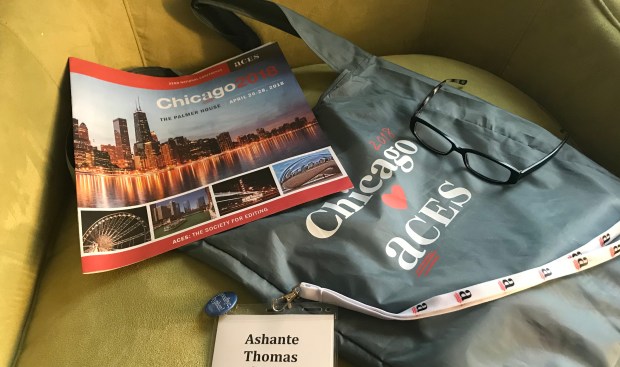
To keep my copyediting skills sharp, I was off to the 2018 national conference of ACES: The Society for Editing in Chicago, IL. It was a great opportunity to learn new practices in the industry. The following are four lessons I’m taking away from the event.
- Language: Understand that we, the people, choose how we use English, which is one reason Merriam-Webster expands and revises its entries annually.
- Bias detection: Follow an inclusion checklist that assumes the writer doesn’t understand why a point is offensive yet do push back, requesting supporting research and consulting an expert. Avoid labels, which means scrutinizing whether an identifier like race is relevant. (You can check out more about that “Is This Biased?” from its handouts.)
- Workplace: Build social capital with colleagues, which means acknowledging when a staff person does a great job so that one can build from that good foundation to confront on and resolve an issue. Now this session was geared toward workplace leaders, but I think it works in collaborative settings too.
- Overall: Don’t give people an excuse to stop reading.
It’s probably a cliché at this point, but I still believe it: the copy editor is often the last line of defense—checking the accuracy of information before it reaches the reader. Every publication from the corporate office to the newsroom needs reliable copy editors—professionals who are the first readers of a writer’s work. These professionals preserve writers’ voice while checking grammar, spelling, and punctuation; reviewing the text structure and flow; and verifying facts. Why do they do that? Because writers, no matter how educated or experienced, immediately lose credibility among readers when they spot errors or are confused by the text. We (copy editors and writers) don’t want to lose our readers; we want our writers’ story to get out.
 Ashante Thomas's Blog